
When the Waters Rise: How Flooding Exposes Infrastructure Vulnerabilities, a Texas Flood Case Study
By Laura Wright
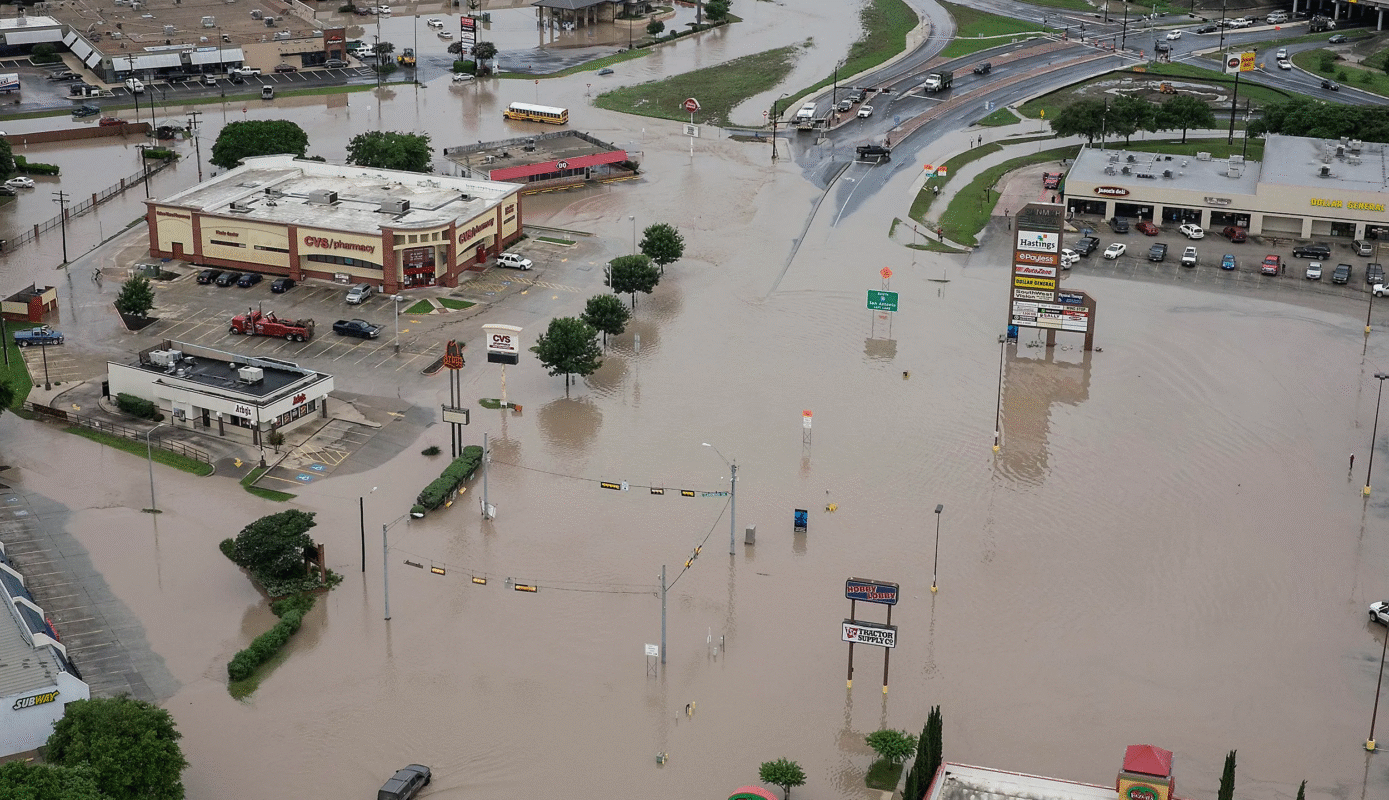
CNN | Rodolfo Gonzalez/Austin American-Statesman/AP
In just the first half of this year, the U.S. had already broken its annual record for flash flood warnings—3,040 alerts compared to 3,023 in all of 1998. Increasing occurrences of flooding, along with other extreme weather events, are not coincidental, rather a symptom of a warming climate [1]. It has been estimated that by year 2100 the average 100-year floodplain will increase by 45%, and annual flooding damages will rise to $750 million [2], [3]. The destruction and peril resulting from these events is only being exacerbated by the outdated and inadequate infrastructure across the United States. More so now than ever we need to be planning our cities and building its infrastructure with resilience and adaptability in mind. These “natural disasters” do not have to become disasters, by taking steps to reduce risks and manage their impacts.
Traditionally, grey infrastructure, such as storm pipes, dams, and seawalls, have been used to manage stormwater, but as rain events have increased in intensity and frequency this infrastructure has become obsolete and insufficient. Green infrastructure (GI) has been a proven measure against flooding in flood-prone areas [4] and should be considered when building cities for the future. GI, such as bioswales, bioretentions, rain gardens, and green roofs, mimic natural hydrological processes, capturing, infiltrating and replenishing stormwater back into the ground. One of civil engineering’s most common challenges is designing for unknown future conditions, which is why the implementation of resilient controls like GI in conjunction with more traditional grey infrastructure approaches is critical when designing developments to handle stormwater in the face of unknown future conditions. The recent devastating flooding in Texas is examined as a case study here to determine how aging and inadequate infrastructure played a role in the impacts of the flood and how a different approach in stormwater management could be helpful in mitigating and preventing destruction. However, these recommendations are not just limited to Texas, but rather an approach that transcends location and could benefit all areas, including Tennessee.
On July 3rd, flash flood warnings were issued for Central Texas, including Kerrville and the surrounding Texas Hill Country. By the morning of the 4th, the Guadalupe River had surged 26 feet in just 45 minutes, reaching its second-highest crest on record [5]. The flood claimed 135 lives, with reports of over 100 people still missing—ranking among the ten deadliest floods in U.S. history [6]. Extensive damage was left in its wake, including the failure of a drinking water treatment plant and, by some estimates, upwards of $18 billion in economic costs due to property damages, search and rescue efforts, lost tourism revenue, etc. [7]. Similar to other natural disasters, the damage and loss from this event was compounded by the state of local and national infrastructure; and the critical systems that were in place either outright failed or were overwhelmed by the event. When devastating events like this happen we tend to ask ourselves, ‘Could something have been done?’ and while authorities and politicians are quick to deflect blame, it’s clear that something could be done to better prepare communities during these extreme weather events. And while it’s not the only answer, improving and updating our stormwater management systems and infrastructure is a simple and achievable solution that can help mitigate the damage and change how these storms impact our communities.
Focusing blame only on outdated and inadequate stormwater systems isn’t enough. It’s equally important to mention how other systems failed, emphasizing the need for improved stormwater systems. This is especially true in the case of the Texas flood since post-event analyses largely attributed the extreme damage and loss of life to shortcomings in warning systems and weather services. The first line of defense in meteorological events like the heavy rains in Texas are our weather services and early warning systems. Both of which proved to be deficient for the residents of Central Texas in early July of 2025. Before the rain began falling, the National Weather Service predicted 7 inches, which was an underestimate, as rain gauges on the South Fork of the Guadalupe River read a total of 12.2 inches [5]. And flash flood warnings should have triggered push notifications to cell phones in the area, but many say they did not receive them[8]. Staffing shortages and lack of data collection may have limited the ability for timely warnings and accurate forecasting. But ultimately, heavy rains would have still overwhelmed the stormwater systems in place. The failure of other critical systems, such as Kerrville’s drinking water treatment facility, and extensive property damage would not have been avoided, thus putting even more importance on having adequate systems to handle increased rainfall.
Stormwater management plays a vital role in how urban and developed areas respond to rainfall and its impact on communities. As mentioned above, grey infrastructure, such as street drains, storm pipes, and dams, have served as the primary means of control. Unlike GI which allows for stormwater infiltration into the ground, these systems are designed to capture and convey runoff to centralized locations for treatment or discharge. However, when rainfall exceeds system capacity, these measures quickly become overwhelmed, leading to flooding.
Runoff conveyance in central Texas is complex due to its arid climate and topography of steep rocky hills, and drainage systems there–like in many U.S. towns and cities—are sorely inadequate in the face of intense storms and growing populations. This compounds damage where many older homes and buildings are not equipped with modern flood protections in flood-prone areas. The lack of sufficient systems capable of conveying and storing runoff led to the flooding of the surrounding residential and commercial areas far past the flood plain, instead of just the burgeoning of the Guadalupe River and other surface waters. According to the Kerr County Hazard Mitigation Action Plan, the City of Kerrville’s investment in improving existing infrastructure in the face of population growth has been ongoing, while also stating climate-driven weather events may exacerbate hazards and it “may necessitate [the] construction of appropriate infrastructure to address these threats” [9]. Furthermore, the failure of Kerrville’s primary water treatment plant showed us how the failure of stormwater infrastructure can affect other critical systems. Flooding in Nimitz Lake damaged the plant’s intake equipment and other key systems, resulting in the City of Kerrville declaring a water supply emergency and enacting Stage 4 Severe Water Conservation Conditions—strict restrictions intended to preserve the limited water supply. It took nearly two months to get the plant operable again, leaving communities reliant on ground water from wells [10].
These events underscore not only the increasing frequency of climate-driven disasters but also the urgent need for resilient infrastructure capable of protecting communities in a rapidly changing environment. Flood mitigation approaches fall into two categories: structural and non-structural. While structural measures are not the most popular since over time old levees and dams have failed, I argue they require more of our attention since so much of our structural solutions are obsolete or deficient. Implementing GI in stormwater management approaches can alleviate the load placed on these existing grey systems by offering an additional route for stormwater to be collected and stored.
GI measures like rain gardens and bioswales allow for the infiltration of rainwater into the ground, resulting in less water flowing into the existing storm pipe system. These control measures also decrease the amount of stormwater flowing to underground systems where they may be combined with sewage systems, which is predominant in Chattanooga’s collection systems. Combined storm and sewer systems pose a particularly dangerous problem when they become overwhelmed because they likely overflow into the streets or waterways, leading to higher rates of exposure to raw sewage. GI stormwater management is an approach that is used in conjunction with grey infrastructure, and not as a singular alternative. This makes it ideal since it does not require the removal and replacement of existing systems–which can be extremely costly– instead these controls can be constructed supplementary to existing systems. Additionally, the innate design of GI controls offers economic and social benefits such as green spaces in our increasingly concrete and asphalt communities, giving developments a greater aesthetic appeal.
At CEG we understand the importance and necessity for both types of systems when designing stormwater management, which is why we believe a balanced approach is often superior to one that relies solely on one type of system. The truth of the matter is that grey infrastructure is necessary to collect and convey stormwater, but relying solely on these static systems when faced with heavy rainfalls is foolish. Supplementary GI measures alleviates the pressures put on these systems when flows exceed their capacity. But GI is not only useful for heavy rains, it is also beneficial during times of normal rainfall, helping to collect and return stormwater to the ground and eliminating the need for costly treatment.
The Texas flood was a stark reminder of how infrastructure resilience determines community outcomes in extreme weather. For developers and municipalities, the lesson is clear: resilient stormwater systems must combine traditional grey infrastructure with proven green infrastructure strategies. At CEG, we design with these challenges in mind—helping clients reduce flood risk, protect critical systems, and build developments prepared for the future.
References:
- Crimmins, M. 2022. ‘How Climate Change Impacts each Type of Natural Disaster.’ PBS. Accessed: September 19, 2025. https://www.pbs.org/wnet/peril-and-promise/2022/09/how-climate-change-impacts-each-type-of-natural-disaster/.
- AECOM, Michael Baker Jr., Inc., and Deloitte Consulting, LLP. 2013. ‘The impact of climate change and population growth on the National Flood Insurance Program through 2100.’
- Wobus, C., M. Lawson, R. Jones, J. Smith, and J. Martinich. 2013. ‘Estimating monetary damages from flooding in the United States under a changing climate.’ Journal of Flood Risk Management. 7 (3), 217-229. https://doi.org/10.1111/jfr3.12043.
- Chang, H and Pallathadka, A. 2025. ‘A case for change: Flood risk management and green infrastructure.’ Cell Reports Sustainability. 2 (4). https://doi.org/10.1016/j.crsus.2025.100369.
- Harvey, C and E&E News. 2025. ‘Texas Flood Forecasts Were Accurate but Not Sufficient to Save Lives.’ Scientific American. Accessed: September 14, 2025. https://www.scientificamerican.com/article/texas-flood-forecasts-were-accurate/.
- Masters, J., Burt, C., and Henson, B. 2025. ‘The Deadliest Floods in US History.’ Yale Climate Connections.
- Lada, B, 2025. ‘Death toll climbs to 120 in Texas floods as search continues for 170 missing.’ AccuWeather. Accessed: September 22, 2025. https://www.accuweather.com/en/weather-news/at-least-100-dead-major-disaster-declared-after-catastrophic-texas-flood/1792013.
- Bush, E. 2025. ‘National Weather Service defends its flood warnings amid fresh scrutiny of Trump staff cuts.’ NBC News. Accessed: September 12, 2025. https://www.nbcnews.com/science/science-news/national-weather-service-nws-staff-cuts-trump-budget-texas-floods-rcna217139.
- Kerr County Hazard Mitigation Action Plan. 2024. Kerr County.
- Delgado, R. 2025. ‘Kerrville’s water plant working again after flood damage.’ San Antonio Express-News. Accessed: September 17, 2025. https://www.expressnews.com/hill-country/article/kerrville-flooding-water-plant-guadalupe-river-20874943.php.