
Before the Change: Q1 2026 Development Activity Through the RPA’s Final Quarter Serving Hamilton County
A review of rezoning applications and subdivision plats from January through March 2026 — what was proposed, where activity concentrated, and what it signals for the market ahead.
In March 2026, Hamilton County commissioners voted to establish its own planning department for unincorporated areas of the county, ending a long-standing relationship with the Regional Planning Agency. The RPA is the professional staff body that has long supported the Planning Commission — researching zoning history, assessing land use compatibility, benchmarking proposals against adopted area plans, and presenting detailed reports before any case is voted on. That work formed the foundation of how development cases in both the city and the county have been evaluated.
In that context, the Q1 2026 record carries an added layer of relevance. We evaluated the RPA’s work from January through March — rezoning applications and subdivision plats across both city and county jurisdictions — to give you a clear picture of what that process produced in its final quarter serving Hamilton County. Whatever the path forward looks like for county planning, this data is a meaningful baseline.
Q1 BY THE NUMBERS
29 rezoning and special permit cases reviewed
672 residential units proposed through rezoning alone
370+ new lots proposed through subdivision plat activity
266 units in a single downtown mixed-use redevelopment proposal
Residential Demand Is the Dominant Story
Of the 29 rezoning cases reviewed in Q1, 16 involved residential proposals — more than half the total docket. These ranged from small infill lots seeking modestly denser zoning to larger parcels being repositioned for townhome and multi-unit development, reflecting sustained demand pressure across both city and county districts.
The scale varied considerably, from single-lot infill proposals to an 11-acre parcel approved for a 50-lot single-family subdivision, to a 23-unit townhouse development approved with conditions in the city. The breadth of the residential docket signals that demand is not concentrated in one type of product or one part of the region — it is broad-based.
Outcomes were mixed, and the most instructive pattern was this: staff recommended denial on a majority of residential cases, most often citing compatibility with adjacent lower-density neighborhoods, floodplain constraints, or misalignment with the applicable area plan. Yet several of those initially denied or deferred cases ultimately advanced after applicants presented directly to the commission. Staff recommendations are advisory — and a well-prepared applicant who understands the record and addresses the concerns directly can change the outcome.
Residential Rezoning — Staff Recommendation vs Final Outcome
16 residential cases reviewed January through March 2026
Subdivision Activity Shows a Deep Lot Pipeline
Beyond rezoning, the Planning Commission reviewed 13 subdivision plat cases in Q1 representing over 370 lots across the region. This layer of activity is arguably the most direct measure of near-term lot supply coming to market — and Q1 showed a pipeline that is meaningfully active across both city and county districts.
Activity was spread across the region, with approved cases ranging from smaller infill subdivisions in established city neighborhoods to larger multi-phase developments in county districts. Hamilton County District 10 stood out, with a 55-lot planned unit development advancing alongside the industrial and rezoning activity discussed below — a sign that this corridor is in an active phase of build-out.
Not every case moved cleanly. Several plat submissions were deferred or denied over incomplete engineering and design submittals — a consistent reminder that even projects with sound underlying concepts can stall when the technical groundwork is not in order before the application is filed.
Subdivision Lot Pipeline Q1 2026
13 plat cases reviewed; 370+ lots proposed across January through March
Commercial Proposals: Staff Is Actively Shaping Outcomes
Commercial rezoning accounted for 11 cases in Q1, and the dominant pattern was staff redirecting applicants away from their requested classification toward something more compatible with surrounding land uses. The C-C Commercial Corridor Zone was the most frequently requested commercial designation — and the one most frequently modified. Staff consistently steered applicants toward the C-TMU Transitional Mixed-Use zone instead, which permits commercial activity while providing more buffering between commercial development and adjacent residential areas.
This pattern showed up across multiple corridors and project types. In several cases, the commission approved the C-TMU alternative with conditions restricting higher-impact uses. In others, proposals were denied outright when compatibility with surrounding neighborhoods could not be reconciled. The consistent message from staff this quarter: commercial applicants who do not account for neighborhood context in their initial design face a difficult path, even on sites where commercial use could otherwise be appropriate.
For developers evaluating commercial sites in the region, the practical takeaway is clear — the zone you request matters less than the zone that fits. Coming in with a proposal already calibrated to what staff is likely to support, rather than negotiating down from a more aggressive ask, tends to produce cleaner outcomes.
Commercial Rezoning Outcomes Q1 2026
11 commercial cases reviewed straight approval was the exception, not the rule
One Case That Stands Apart: Downtown at Scale
The most significant single case of the quarter involved a half-acre site on Patten Parkway in downtown Chattanooga where a rezoning request would enable a mixed-use redevelopment featuring 266 residential units. The case was deferred in January for further review, but at over 500 units per acre of proposed residential density, it reflects a level of confidence in the urban core that puts it in a different category from the rest of the Q1 docket.
Whether or not the project advances in its current form, this type of proposal signals that larger capital is actively evaluating downtown Chattanooga for meaningful density. It is a trend worth monitoring closely as the city’s form-based zoning framework matures and more infill opportunities emerge in the urban core.
Industrial: One Case in Hamilton County District 10, a Clear Signal
Only one case in Q1 involved an industrial rezoning, but it is instructive — and it landed in Hamilton County District 10, a district that showed up repeatedly across the quarter’s rezoning and subdivision activity. A 2.73-acre parcel on Mountain View Road was rezoned from residential to M-2 Wholesale and Light Industry, approved with conditions over community opposition. The added conditions included a prohibition on standalone retail and a three-story height cap, reflecting the commission’s effort to balance industrial use with nearby residential areas.
What makes this case meaningful for developers is the plan alignment: the site’s designation under Plan Hamilton — the county’s long-range land use framework — is Industrial. That designation signaled that even over neighbor objection, the commission would approve a use consistent with the county’s own vision for the corridor. Hamilton County District 10 is a district to watch. It appeared in rezoning, subdivision, and industrial cases across all three months of Q1, and the planning framework is increasingly positioning it for productive commercial and industrial build-out.
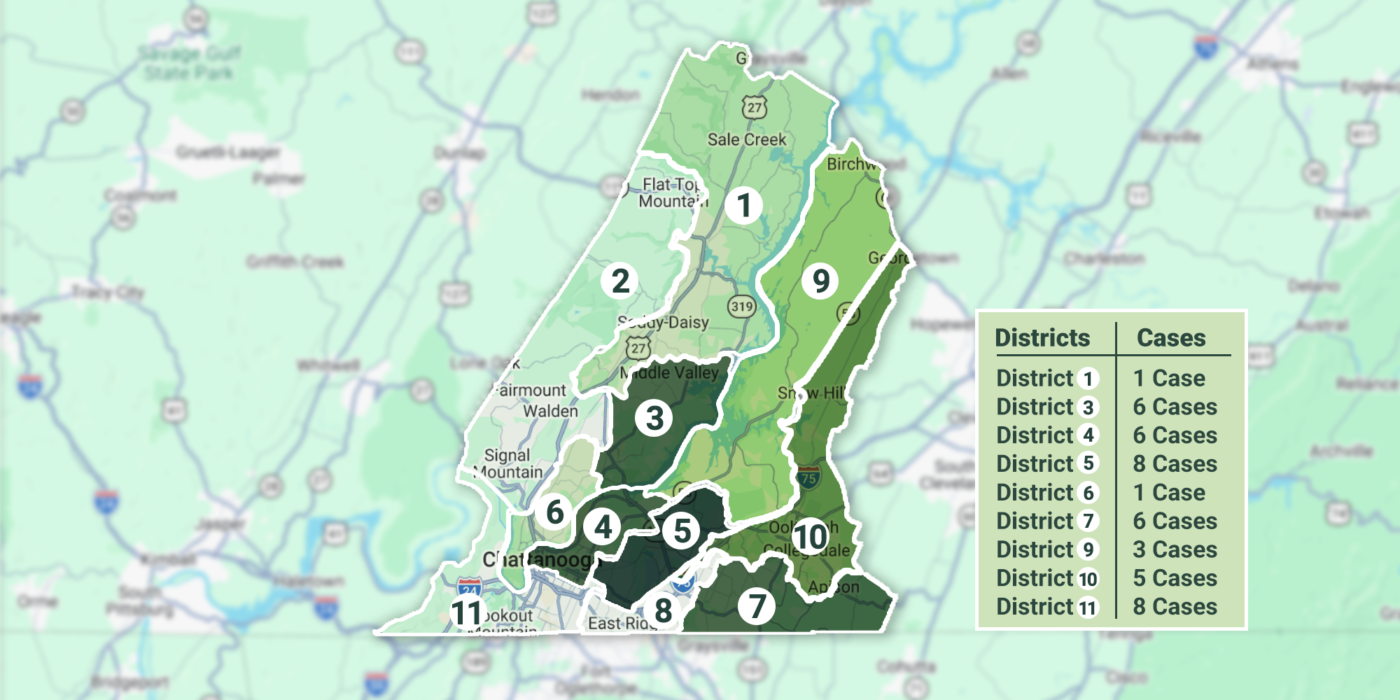
Q1 Development Activity by District
Combined rezoning and subdivision plat cases. HC = Hamilton County.
City District 5 appeared in rezoning, subdivision, and industrial cases all three months.
What This Means If You Are Planning a Project
The Q1 record points to a market that is actively pushing toward more density and more diverse use across both city and county districts — within a regulatory environment that is increasingly deliberate about how that growth is shaped. Staff is not simply approving or denying. They are steering: toward compatible zone classifications, toward conditions that buffer impacts, toward designs that align with adopted area plans.
The practical implication is that early engagement with the planning process is no longer optional. Projects that arrive at the commission fully aligned with the applicable area plan, with conditions already proposed and technical submittals complete, move more cleanly than those that do not. And when staff recommends denial, the record this quarter shows clearly that a well-prepared applicant presenting directly to the commission can still change the outcome.
CEG works with clients throughout this process — from initial site evaluation and zoning analysis through engineering design and entitlement support. If you are evaluating a site or preparing to move a project forward in the Chattanooga region, we welcome the conversation.